
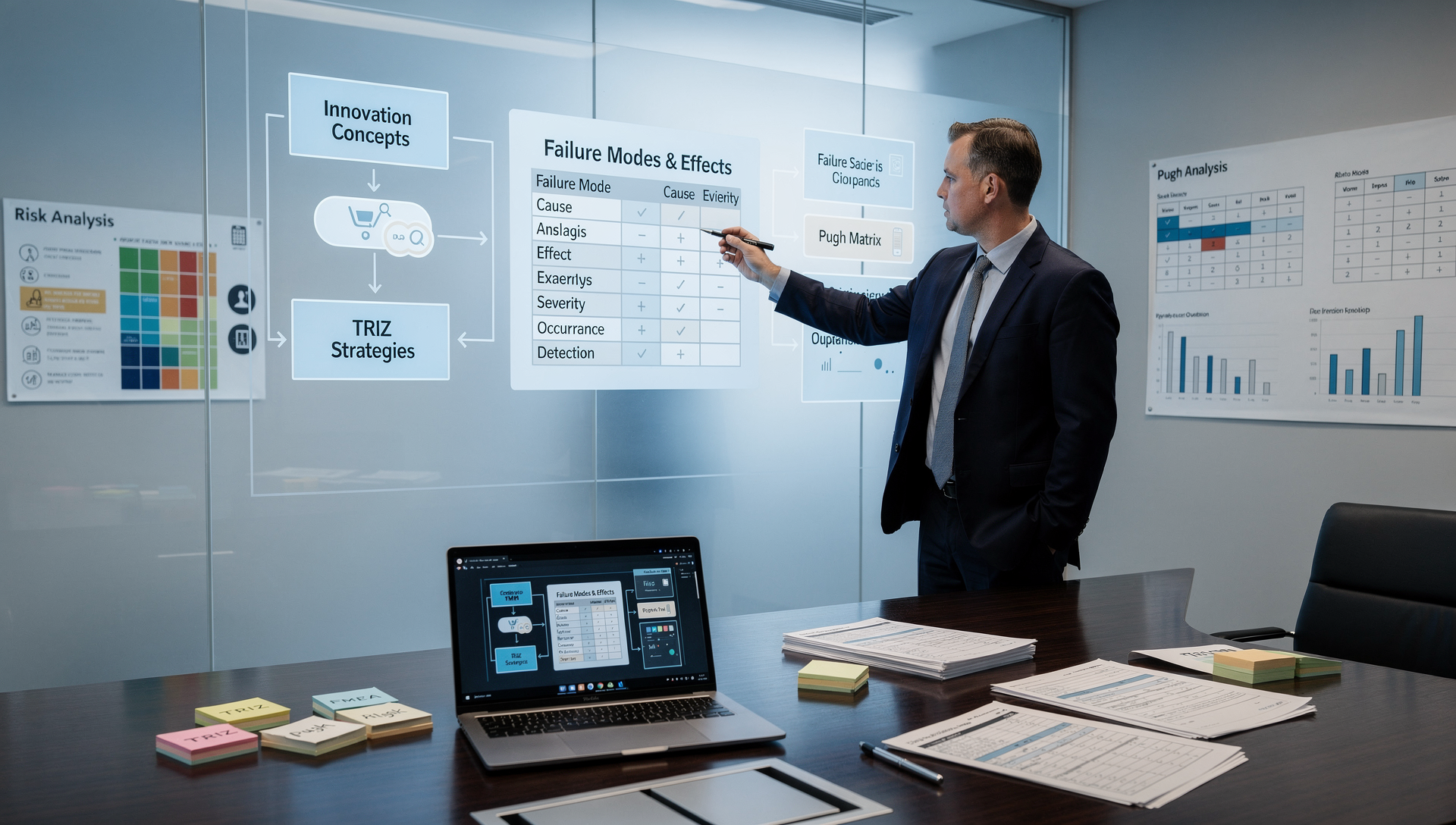
Organisations often struggle with the same problem in process improvement and innovation: they generate ideas, assess risks, and compare options, but they do not always do these in a connected way. As a result, creative ideas can be lost too early, low-risk options can be selected even when they add little value, or teams can choose a preferred solution without a disciplined comparison of alternatives.
A stronger approach is to combine three well-established methods into one practical decision-making model: TRIZ, FMEA, and the Pugh Matrix.
Used together, these methods create a structured pathway from problem definition to concept generation, risk evaluation, and final option selection. TRIZ helps teams think inventively and solve contradictions. FMEA helps them identify and prioritise risks. The Pugh Matrix helps them compare alternative concepts against agreed criteria. The result is a model that is both creative and disciplined.
Why combine these three methods?
Each of the three tools does a different job.
TRIZ is strong at generating inventive solutions. It helps teams move beyond obvious ideas and tackle contradictions in the system. It is particularly useful when the problem appears stuck or when improving one aspect of performance seems to worsen another.
FMEA is strong at structured risk thinking. It forces the team to ask what could fail, why it might fail, and what the consequences would be. It introduces discipline and prevents teams from becoming overconfident about attractive concepts.
The Pugh Matrix is strong at option selection. It helps compare multiple concepts against a baseline or reference option using agreed criteria. It reduces the tendency to choose based on personality, habit, or the loudest voice in the room.
On their own, each method has value. Together, they form a more complete model:
- TRIZ generates better options
- FMEA improves understanding of risk
- Pugh supports rational choice between alternatives
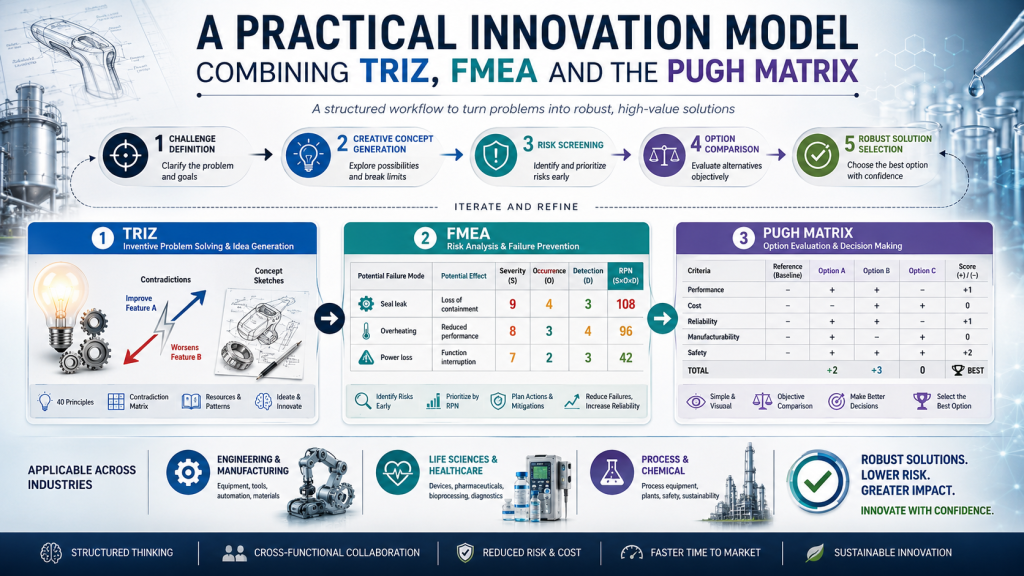
The integrated model
A practical model combining TRIZ, FMEA, and the Pugh Matrix can be described in six stages.
1. Define the challenge clearly
The first step is to define the problem in a disciplined way.
This includes:
- the process or system under review
- the current pain points
- the desired improvement
- the constraints
- the contradiction, if one exists
For example, a team may define a challenge like this:
We need to reduce process cycle time without increasing quality risk or operator burden.
This is a strong starting point because it is not just a vague wish to “improve the process.” It identifies the tension that needs to be resolved.
2. Use TRIZ to generate solution concepts
Once the challenge is defined, TRIZ is used to generate possible concepts.
The key value of TRIZ here is that it pushes teams beyond incremental thinking. Rather than asking only, “What small change can we make?”, TRIZ asks:
- What contradiction exists?
- What inventive principles may help resolve it?
- What would an ideal solution look like?
- How have similar contradictions been solved elsewhere?
This stage should generate several distinct concepts, not just one preferred idea.
For example, if the goal is to reduce manual checking while maintaining compliance, TRIZ may lead to concepts such as:
- automated in-process verification
- error-proofed digital entry
- parallel approval logic based on risk
- self-checking workflow design
- real-time exception alerts instead of full manual review
The output of this stage is a shortlist of concept options.
3. Screen concepts at a high level
Before moving into detailed evaluation, the team should carry out a quick practicality screen.
This asks:
- Is the concept technically possible?
- Is it within scope?
- Is it aligned with strategic and regulatory constraints?
- Is it obviously impractical or too expensive?
This is not the final decision stage. It is simply a filter to remove unrealistic ideas before deeper analysis begins.
4. Apply FMEA to the shortlisted concepts
The next stage is to apply FMEA to each viable concept.
This is where the model becomes especially powerful. Teams often choose concepts because they appear innovative or efficient, but FMEA forces them to examine potential failure modes before committing.
For each concept, the team identifies:
- possible failure modes
- effects of failure
- causes of failure
- current controls
- severity, occurrence, and detection
- priority areas for mitigation
This helps the team distinguish between:
- concepts that are strong and manageable
- concepts that are attractive but fragile
- concepts that require additional controls before adoption
The role of FMEA here is not to eliminate all risk. It is to improve understanding of risk and make the decision more informed.
For example, one concept may offer major cycle-time improvement but introduce a higher chance of undetected data-entry error. Another may be slower to implement but inherently more robust. FMEA helps make that visible.
5. Use the Pugh Matrix to compare the concepts
After inventive generation and risk analysis, the team can move to structured comparison.
The Pugh Matrix is used to compare options against a baseline or reference concept using agreed criteria. These criteria might include:
- impact on cycle time
- quality robustness
- implementation cost
- ease of validation
- operator usability
- scalability
- regulatory acceptability
- residual risk after mitigation
Each concept is compared against the reference using a simple scoring approach such as:
- better than baseline (+)
- same as baseline (S)
- worse than baseline (-)
Or, if more detail is needed, a weighted numerical scale can be used.
The value of the Pugh Matrix is that it prevents the decision from becoming over-influenced by one attractive feature. A concept should not win only because it is clever. It should be selected because it performs strongly across the criteria that matter most.
6. Refine and select the preferred solution
The final stage is not just to pick a winner, but to refine the best concept.
In many cases, the best outcome is not one original idea in pure form. It may be a hybrid solution that combines the strongest elements of multiple concepts.
At this point, the team can:
- select the preferred concept
- define required risk controls
- identify implementation actions
- document the rationale for selection
- prepare for piloting or project execution
This creates a stronger basis for approval, investment, and stakeholder buy-in because the selected concept has been:
- creatively generated
- risk assessed
- comparatively evaluated
What the model looks like in simple form
The model can be summarised as:
Problem Definition → TRIZ Concept Generation → Practical Screening → FMEA Risk Analysis → Pugh Matrix Comparison → Refined Solution Selection
This sequence matters.
If the team starts with FMEA alone, it may become too conservative too early.
If it starts with the Pugh Matrix alone, it may compare weak or obvious options.
If it uses TRIZ alone, it may produce creative ideas without enough discipline around risk and selection.
The strength of the model lies in the order.
Benefits of the combined approach
This integrated model offers several clear benefits.
Better quality of ideas
TRIZ improves the originality and usefulness of the solution concepts.
Better visibility of risk
FMEA exposes weaknesses early and allows mitigation to be built into the concept.
Better decision quality
The Pugh Matrix provides a transparent method for selecting between options.
Better cross-functional engagement
The model encourages input from engineering, quality, operations, validation, and management.
Better documentation of rationale
The organisation can show not only what solution was chosen, but why it was chosen.
Where this model works well
This model is especially useful in:
- process redesign
- product development
- equipment selection
- digital transformation projects
- quality improvement initiatives
- validation and compliance-related design decisions
- operational excellence programmes
It is particularly valuable where there is both innovation pressure and risk sensitivity, such as in life sciences, medical devices, advanced manufacturing, and regulated operations.
Example application
Imagine a pharmaceutical manufacturer wants to redesign a batch review process.
The challenge is to reduce review time without weakening compliance.
Using the model:
- TRIZ generates several concepts, such as exception-based review, automated data checks, modular review by risk, and integrated real-time release support.
- FMEA is then applied to each concept to identify risks such as missed critical deviations, poor data integrity, user confusion, or system failure.
- The Pugh Matrix compares the concepts using criteria such as speed, compliance strength, validation burden, cost, and usability.
- The outcome may be a hybrid concept: automated low-risk checks plus targeted human review for high-risk exceptions.
This is far stronger than jumping directly to “buy software” or “add more reviewers.”
Conclusion
A model combining TRIZ, FMEA, and the Pugh Matrix provides a powerful framework for smarter innovation and decision-making.
TRIZ helps teams think beyond the obvious.
FMEA ensures risks are understood before commitment.
The Pugh Matrix supports disciplined selection between alternatives.
Together, they create a balanced model that is creative, analytical, and practical. In environments where organisations need better decisions rather than just more ideas, this combined approach can be especially valuable.