
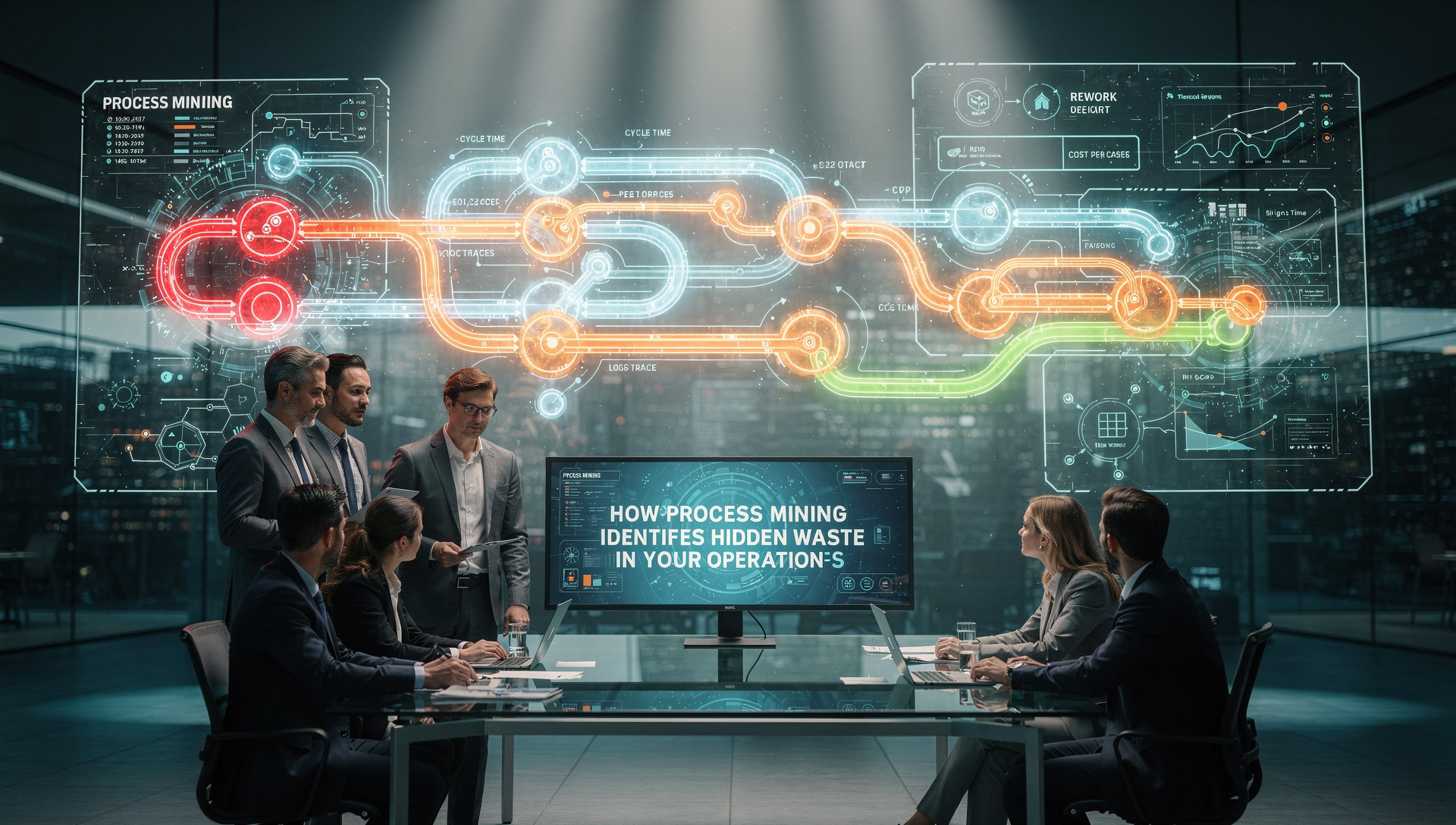
Most organisations believe they understand their processes. They have SOPs, process maps, and documented workflows that describe how work is supposed to happen. But there is often a significant gap between the documented process and the real process—the one that actually runs day to day.
That gap is where waste hides.
Process mining has emerged as one of the most powerful ways to close that gap. It does not rely on assumptions, workshops, or interviews alone. Instead, it uses system data to reconstruct how processes actually flow, revealing inefficiencies that are often invisible to traditional improvement methods.
The problem: You can’t improve what you can’t see
Traditional process improvement approaches depend heavily on perception.
Teams map processes based on:
- how they think work happens
- how it is supposed to happen
- how they would like it to happen
But reality is more complex.
In practice, processes often include:
- undocumented steps
- workarounds
- repeated loops
- delays between activities
- inconsistent execution across teams
These variations are rarely captured in standard process maps. As a result, organisations try to improve a version of the process that does not truly exist.
Process mining changes this by showing the actual flow of work, based on real data.
What process mining actually does
At its core, process mining takes event data from systems—such as ERP, CRM, MES, or QMS—and reconstructs the sequence of activities that make up a process.
It answers questions like:
- What paths does the process actually follow?
- How long does each step take?
- Where do delays occur?
- How often do steps repeat?
- Where do cases deviate from the expected path?
This creates a data-driven view of the process, not a theoretical one.
And it is within this real view that hidden waste becomes visible.
Where hidden waste typically exists
Once a process is visualised using process mining, several forms of waste tend to emerge.
1. Waiting time
One of the most common—and least visible—forms of waste is waiting.
A process step may take only minutes to complete, but the time between steps may be hours or days. These delays are often caused by:
- handoffs between teams
- approval queues
- lack of visibility
- competing priorities
Process mining highlights these gaps clearly, showing where work is sitting idle rather than progressing.
2. Rework and loops
Processes rarely follow a straight path.
Cases may move forward, then backward, then forward again. This can happen due to:
- incomplete information
- errors in execution
- unclear requirements
- poor data quality
These loops are difficult to identify manually, but process mining makes them visible by showing how often steps are repeated and where the process cycles unnecessarily.
3. Variability in execution
A “standard” process often turns out to have dozens—or even hundreds—of variations.
Different teams, individuals, or systems may execute the same process differently. This creates inconsistency, which leads to:
- unpredictable outcomes
- quality issues
- inefficiency
Process mining reveals this variation by mapping all the different paths a process can take, not just the ideal one.
4. Bottlenecks
Bottlenecks are often assumed rather than proven.
Teams may believe a particular step is the constraint, but process mining can confirm whether this is actually the case. By analysing throughput and cycle times, it identifies where work accumulates and where flow slows down.
In many cases, the real bottleneck is not where people expect it to be.
5. Unnecessary steps
Over time, processes tend to accumulate extra steps.
These may have been added for:
- compliance
- control
- historical reasons
But not all of them remain necessary.
Process mining helps identify steps that:
- add little value
- occur infrequently
- create delays without improving outcomes
This provides a strong basis for simplification.
Why this matters more in a digital world
As organisations digitise and automate their processes, hidden waste becomes more problematic.
In a manual environment, inefficiencies are often contained. In a digital environment, they can scale rapidly.
For example:
- automating a process with delays simply makes delays more structured
- digitising rework makes it harder to detect and remove
- adding AI to a poorly designed workflow amplifies inconsistency
This is why process mining is increasingly seen as a prerequisite for digital transformation.
It ensures that organisations understand their processes before they attempt to optimise or automate them.
Moving from insight to improvement
Identifying waste is only the first step. The real value of process mining comes from acting on the insights it provides.
This typically involves:
- redesigning workflows to reduce waiting time
- eliminating unnecessary steps
- standardising execution where appropriate
- improving data quality at key points
- clarifying ownership and decision-making
Process mining provides the evidence needed to make these changes confidently. Instead of relying on opinion, organisations can base decisions on data.
The shift from perception to reality
One of the most important contributions of process mining is that it changes how organisations think about their processes.
It replaces:
- assumption with evidence
- opinion with data
- theory with reality
This shift is powerful because it removes ambiguity. Teams no longer debate how a process works—they can see it.
And once the real process is visible, improvement becomes much more focused and effective.
Conclusion
Hidden waste exists in every organisation. It sits in delays, rework, variability, and unnecessary complexity. Traditional approaches often struggle to uncover it because they rely on incomplete views of how work actually happens.
Process mining changes that.
By providing a clear, data-driven view of real workflows, it exposes inefficiencies that would otherwise remain hidden. It allows organisations to move beyond surface-level improvement and address the underlying causes of poor performance.
In a world where digital transformation, automation, and AI are accelerating, this visibility is more important than ever.
Because before you improve a process, automate it, or apply AI to it, you need to answer one fundamental question:
How does the process really work?
Process mining gives you that answer—and that is where real improvement begins.