
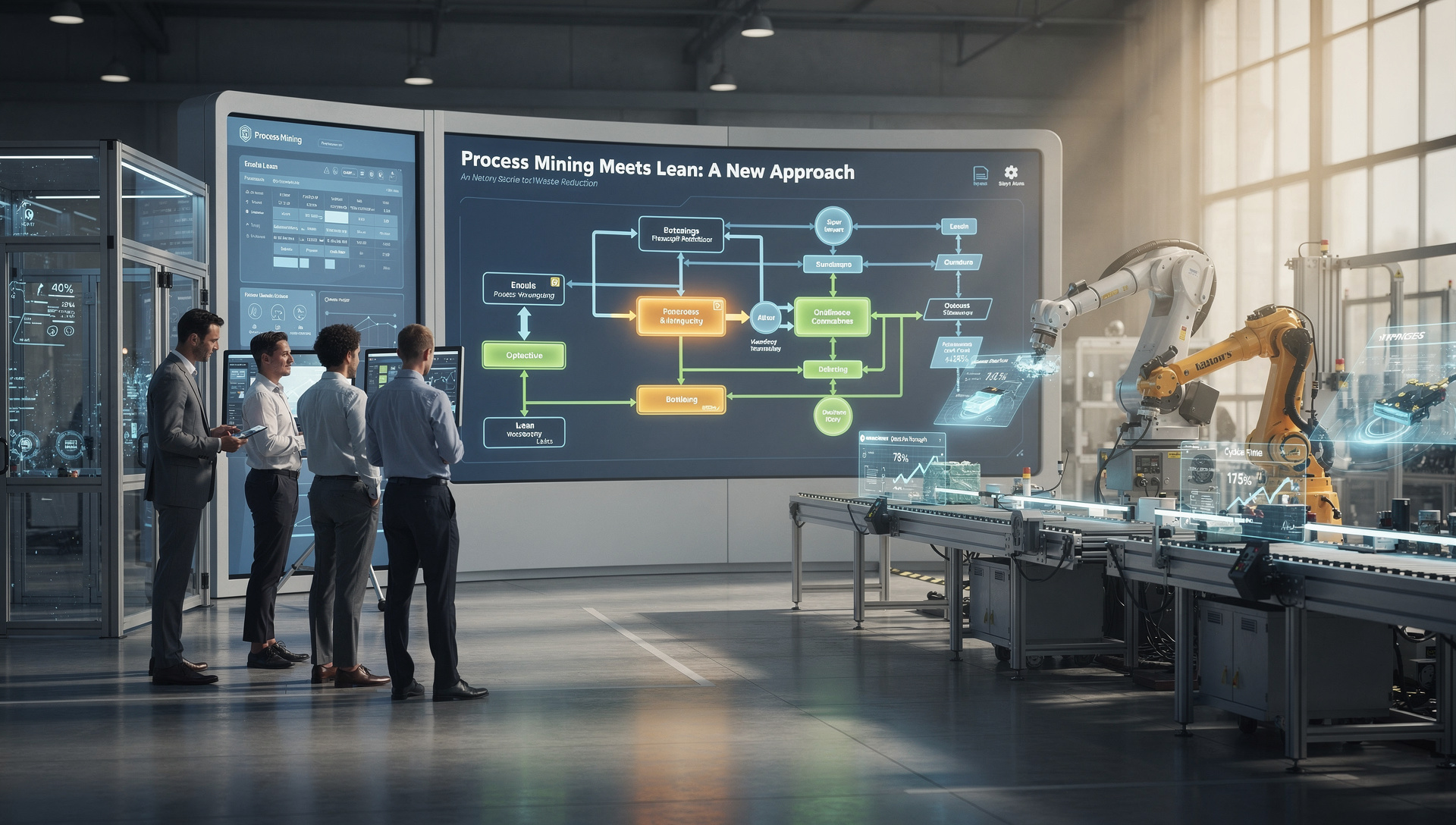
Lean has always been about one thing: removing waste to improve flow. For decades, organisations have used tools like value stream mapping, Gemba walks, and continuous improvement workshops to identify inefficiencies and redesign processes. These approaches have delivered real value, but they share one limitation—they depend heavily on observation, perception, and point-in-time analysis.
Process mining changes that.
By combining Lean thinking with process mining, organisations now have the opportunity to move from observed waste to measured waste, and from periodic improvement to continuous, data-driven optimisation. This combination is not a replacement for Lean—it is an evolution of it.
From seeing waste to measuring it
Traditional Lean methods rely on understanding how work happens on the ground. Teams observe processes, map workflows, and identify non-value-added activities. This is powerful, but it is also limited. It captures a snapshot in time and often reflects how people believe the process operates rather than how it actually behaves across thousands of transactions.
Process mining introduces a different lens. It uses system data to reconstruct the real flow of work across every case, every variation, and every exception. Instead of asking, “Where do we think the waste is?” it answers, “Where is the waste actually occurring, how often, and at what cost?”
This shift is significant. Waste is no longer something you infer—it becomes something you can quantify and prioritise.
Revealing the hidden forms of waste
Lean traditionally identifies eight types of waste: defects, overproduction, waiting, non-utilised talent, transportation, inventory, motion, and extra processing. Process mining brings these to life in a digital environment.
Waiting time becomes visible as gaps between process steps, often revealing that the biggest delays are not in the work itself, but in the handoffs between teams. Rework and defects appear as loops in the process, where cases move backwards and repeat steps unnecessarily. Overprocessing is exposed through additional activities that occur without improving outcomes. Variation becomes measurable, showing how the same process is executed differently across teams, systems, or regions.
What makes this powerful is scale. Instead of analysing a small sample, process mining looks at the entire population of process instances. It reveals patterns that would be impossible to detect through manual observation alone.
From static mapping to dynamic flow
Value stream mapping has long been a core Lean tool, helping teams visualise the flow of materials and information. However, it is inherently static. It represents the process as it exists at a specific moment.
Process mining transforms this into a dynamic view of flow. It shows how the process behaves over time, how it changes under different conditions, and where performance breaks down. It allows organisations to move beyond designing an ideal future state and instead focus on improving the actual current state, continuously.
This is particularly important in complex, digital environments where processes are no longer linear and stable. They are adaptive, cross-functional, and often highly variable.
Prioritising improvement where it matters most
One of the biggest challenges in Lean is deciding where to focus improvement efforts. Without clear data, teams may prioritise issues based on perception or visibility rather than impact.
Process mining removes this uncertainty. It highlights:
- which steps contribute most to cycle time
- where delays are most frequent
- which variations lead to poor outcomes
- how often rework occurs
This allows organisations to focus on the critical few issues that drive the majority of inefficiency, rather than spreading effort across too many initiatives.
It brings a level of precision to Lean that was previously difficult to achieve.
Strengthening root cause thinking
Lean emphasises root cause analysis—understanding not just what is happening, but why. Process mining enhances this by providing evidence.
Instead of relying on assumptions, teams can trace exactly how a problem unfolds:
- where the process deviates
- what conditions lead to failure
- how different paths produce different outcomes
This creates a stronger foundation for problem-solving. It reduces debate and aligns teams around a shared, data-driven understanding of the issue.
Enabling continuous improvement at scale
Perhaps the most important shift is in how improvement is sustained.
Traditional Lean initiatives often occur in waves—projects, events, or focused improvement cycles. While effective, they can lose momentum over time.
Process mining enables a more continuous approach. Because data is constantly being generated, processes can be monitored in real time. Organisations can:
- track performance continuously
- detect emerging issues early
- measure the impact of changes
- adjust quickly
This turns improvement from an event into a capability.
Bridging the gap between digital and operational excellence
As organisations invest in digital transformation, there is a growing risk of automating inefficient processes. Lean has always warned against this—“do not automate waste.”
Process mining provides the visibility needed to avoid that trap. It ensures that organisations understand their processes before they digitise or automate them. It bridges the gap between operational excellence and digital transformation by ensuring that technology is applied to optimised workflows, not flawed ones.
This is especially important as AI becomes more prevalent. AI can enhance processes, but only if those processes are well designed. Otherwise, it simply accelerates inefficiency.
A new model for waste reduction
The combination of Lean and process mining creates a new model for waste reduction:
- Lean provides the principles: focus on value, eliminate waste, improve flow
- Process mining provides the evidence: where waste exists, how it behaves, and how it impacts performance
Together, they enable organisations to move from:
- intuition to insight
- periodic improvement to continuous optimisation
- local fixes to system-wide change
Conclusion
Lean has always been about seeing waste and improving flow. Process mining extends that vision by making the invisible visible and the measurable actionable.
In today’s digital environment, where processes are complex, data-rich, and constantly evolving, this combination is becoming essential. It allows organisations to understand how work really happens, identify where value is lost, and focus improvement efforts where they will have the greatest impact.
Process mining does not replace Lean—it strengthens it.
And together, they provide a far more powerful approach to one of the oldest challenges in operations:
How do we remove waste and create flow in a system that is constantly changing?